Other map types
Reference and locator maps
A reference map shows no data, only geography: coverage area, admin areas, towns, borders, roads. A locator map is the simplest kind: it shows where one place is. Use them to orient readers, or to show a route or border crossing.
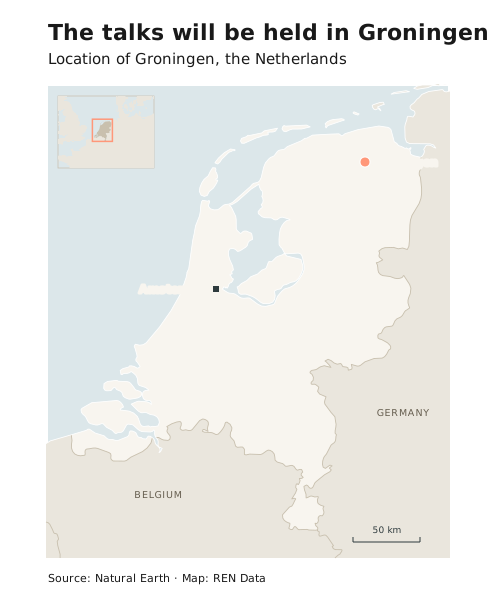
- Use the location basemap.
- Show the minimum: the capital, the place in the story and nothing else, usually at one admin level.
- Mark the place in Coral. Add a locator to put the country in its region.
- Avoid them when you need to show variable data such as incidents. Use a thematic map instead.
Highlight areas
An outlined box with a label tab names an area without hiding what is under it. Use it to point out where something happened or changed.
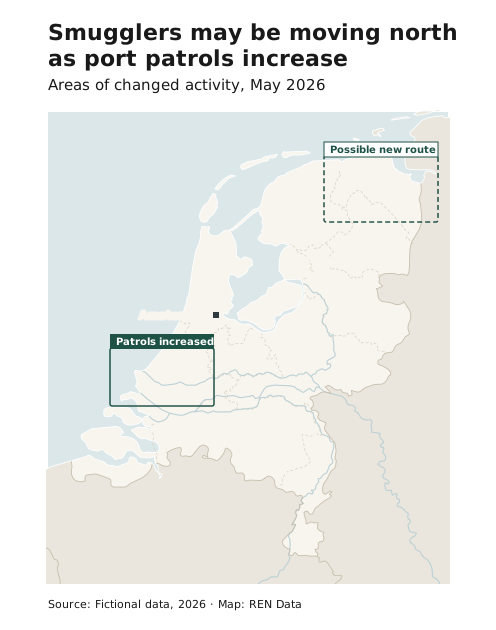
- Draw the outline at 1.5 px in
#1F5247. Use a solid line for confirmed and a dashed line for possible. - Put the label in a tab on top of the box: white on
#1F5247when confirmed,#1F5247on white when possible. - Use two boxes per map at most, and no fills.
Routes and flow maps
A routes map shows where things move: supply routes, migration paths, trafficking routes. A flow map also shows how much, with line width.
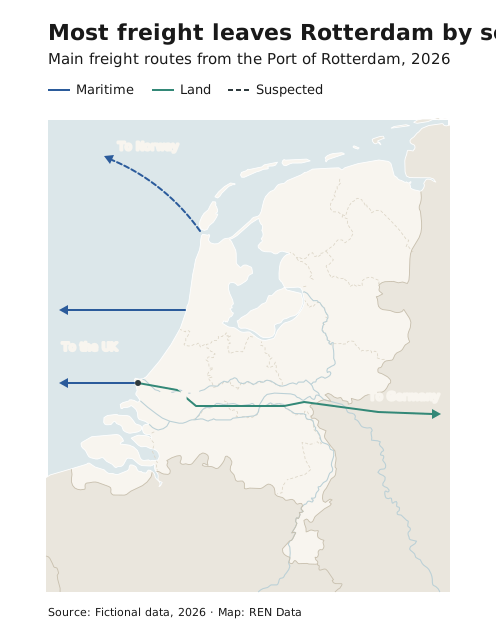
- Draw routes at 2 px, with a small solid arrowhead.
- Use colour for the mode, such as maritime or land, and at most three modes. Use dashes for uncertainty: a dashed route is suspected.
- Draw smooth or straight lines. Don’t trace every bend in the road.
- Give destinations off the map a short label at the arrow: “To Germany”.
- Scale flow lines to the volume, and include a width key.
- The main risk is clutter. When lines cross too often, simplify the routes, merge flows or show only the largest ones.
Isoline map
An isoline map draws lines of equal value across a continuous surface, such as travel time to the nearest clinic, temperature or interpolated survey results.
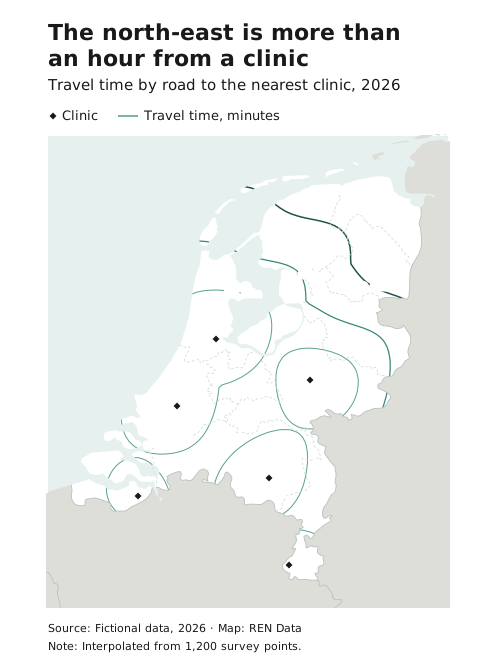
- Use it only when the phenomenon really changes smoothly across space, and when there are enough measurement points.
- With sparse or sharply varying data, an isoline map looks precise when it isn’t. Use points or areas instead.